
Overview
Sourcing from a reliable China bone conduction headphone factory requires evaluating acoustic transducer stability, waterproof engineering, and flexible supply chain fulfillment. As a direct production partner, we outline technical sourcing criteria for global distributors.
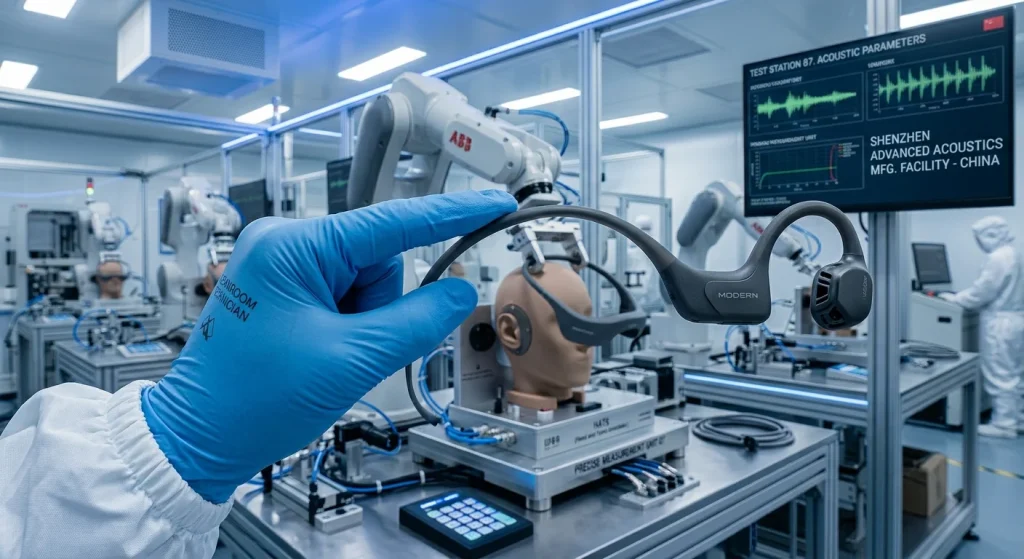
Acoustic Transducer Calibration and Sound Spillage Control
Evaluating open-ear audio hardware starts with understanding transducer performance and internal acoustic dampening. Bone conduction technology bypasses the eardrum, transmitting sound waves through temporal bone vibrations. Maintaining clear voice and musical reproduction while preventing unwanted acoustic leakage depends entirely on precise mechanical alignment within the earphone housing.
Advanced manufacturing facilities utilize automated frequency-response sweep systems to test harmonic distortion across every production batch. Integrating specialized damping gaskets around the driver assembly minimizes unwanted structural resonance. When sourcing true bone conduction headphones, global buyers must verify that manufacturers calibrate transducer drivers under strict inline testing protocols to ensure acoustic uniformity.
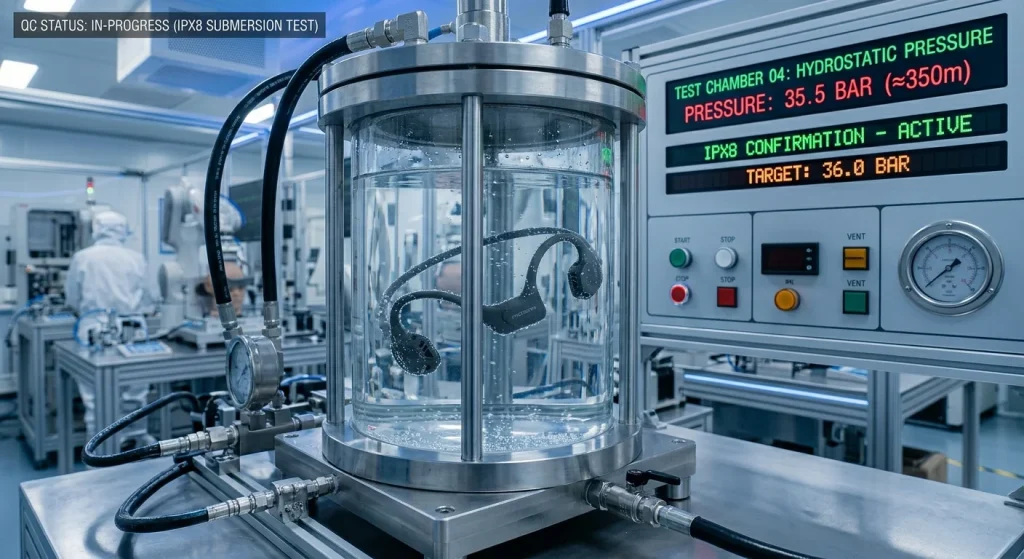
IPX8 Structural Sealing and Underwater Hydrostatic Testing
Aquatic wearable devices require significantly stricter assembly tolerances than standard sweat-resistant sports gear. Manufacturing reliable swimming earphones demands multi-stage physical sealing aligned with Ingress Protection testing protocols, including ultrasonic enclosure welding and precision rubber gaskets.
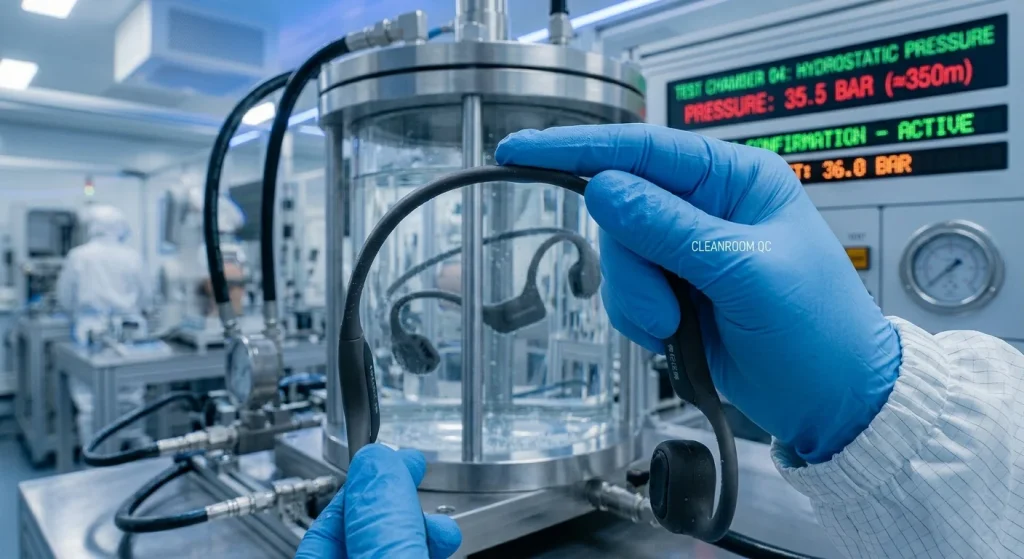
Factory testing workflows must go beyond basic splash checks. Reputable suppliers execute automated air-pressure decay testing to verify cavity integrity prior to final assembly, followed by submersed pressure chambers simulating deep water exposure. Sourcing authentic ipx8 bone conduction headphones requires reviewing factory leak-rate thresholds and thermal shock testing reports to mitigate long-term field failure rates.
Quality Assurance Standards and Material Durability
B2B procurement teams evaluating audio suppliers must inspect raw material quality, assembly consistency, and pre-shipment aging procedures. Headband structural integrity relies on high-grade nickel-titanium shape-memory wire coated in skin-friendly silicone, which must endure thousands of bending cycles without losing clamping force or suffering surface cracking.
Reliable assembly operations enforce strict Acceptable Quality Limit standards for cosmetic finishing, wireless connection stability, and battery capacity retention. Every production run undergoes a mandatory 48-hour active burn-in test to weed out infant mortality electronic components before export packing. To review our production facilities, testing equipment, and quality management systems, buyers can inspect our detailed production and quality assurance processes.
OEM Customization and Private Label Engineering
For e-commerce brands scaling on Shopify and Amazon, transforming reference designs into distinct product lines requires comprehensive OEM/ODM capabilities. Customization extends well beyond surface laser engraving to include custom Bluetooth pairing names, tailored equalizer sound profiles, bespoke silicone colorways, and retail-ready packaging design.
Partnering with an experienced manufacturing provider simplifies mold adaptations and firmware integration. Factories capable of full engineering support enable private label brands to establish clear market differentiation without incurring prohibitive tooling costs or excessive project lead times.
Supply Chain Integration, Low MOQ, and Order Fulfillment
Managing inventory risk and capital flow remains vital for growing electronic brands entering the wearable audio market. Flexible supply chain partners accommodate low minimum order quantities for initial trial shipments while maintaining scalable production capacity to fulfill major seasonal volume orders.
Modern manufacturing suppliers provide value-added logistics support, including Amazon FBA barcode labeling, custom carton markings, and compliant dangerous goods documentation for lithium batteries. These integrated export services empower digital brands to maintain lean holding inventories while ensuring rapid, compliant delivery to end consumers across North America and Europe.
Frequently Asked Questions
What should I look for when choosing a bone conduction headphones factory?
Buyers should evaluate a factory’s acoustic calibration capability, waterproofing test standards, and IPX8 enclosure technology. Ensure the supplier operates cleanroom assembly areas, maintains automated air-leakage test rigs, and possesses international compliance certifications such as CE, FCC, and RoHS.
Compared to standard factories, YAYAGG focuses on specialized acoustic transducer tuning, low defect rates, and comprehensive supply chain support for global B2B clients.
What certifications should a headphone supplier have?
A reliable manufacturer must hold fundamental quality management credentials like ISO9001, alongside product-level compliance marks including CE, FCC, RoHS, and MSDS/UN38.3 for integrated lithium batteries.
For startups and Amazon sellers, YAYAGG supports full certification documentation packages to streamline customs clearance and platform compliance across European and North American markets.
What is the typical MOQ for custom bone conduction headphones?
Minimum Order Quantities vary depending on the depth of customization. Standard private label branding using existing tooling generally requires 500 to 1,000 units, whereas full ODM custom colorways or custom tooling may start at 2,000 units.
In the industry, YAYAGG provides flexible MOQ policies for small-batch market testing, allowing growing brands to scale inventory efficiently.
How do manufacturers test waterproof swimming headphones?
Factories utilize two primary testing phases: dry air-pressure decay testing to check cavity integrity, followed by actual water submersion pressure tanks that simulate depth exposure.
YAYAGG works with brands that require strict AQL quality standards, subjecting 100% of swimming units to positive air-pressure sealing tests prior to final assembly.
Elevate your audio product catalog with premium open-ear devices engineered to strict international export standards. Whether you are expanding your retail inventory or developing a custom private label collection, our engineering and logistics teams are ready to support your business expansion. To request our latest wholesale price list, evaluate product samples, or discuss your custom manufacturing specifications, contact our wholesale team today and get your project moving forward.