
Overview
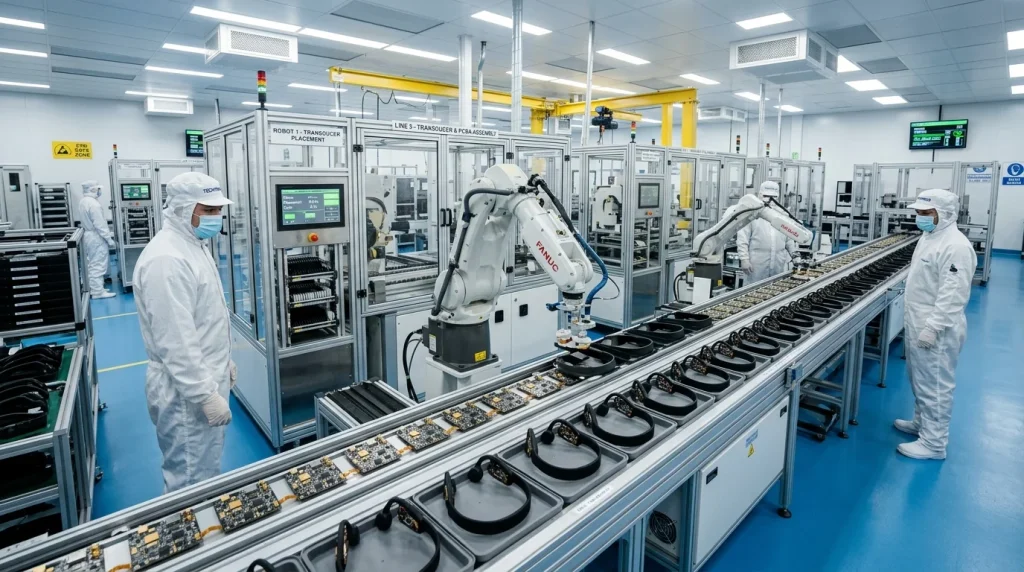
Inside our bone conduction headphones factory, we maintain strict IPX8 waterproofing controls, SMT assembly standards, and automated acoustic transducer testing. This operational guide details our production workflow, quality metrics, and private label fulfillment capabilities for global B2B sourcing partners.
Transducer Assembly & SMT Precision Engineering
Acoustic driver precision forms the foundation of true bone conduction headphones. Our surface-mount technology (SMT) lines integrate bone conduction transducers into moisture-resistant housings, preventing acoustic leakage while maintaining optimal vibration conductivity against the temporal bone.
Unlike conventional air-conduction speakers, bone conduction drivers require exact mechanical calibration during housing insertion. Automated alignment jigs ensure driver contacts remain balanced, eliminating distortion during high-volume audio playback and extending internal transducer lifespan.
IPX8 Hydro-Pressure Testing & Ultrasonic Enclosure Sealing
Manufacturing durable swimming bone conduction headphones demands structural encapsulation rather than superficial hydrophobic coatings. We utilize ultrasonic welding to fuse outer casing seams, creating a hermetic seal capable of resisting continuous water pressure during active aquatic use.
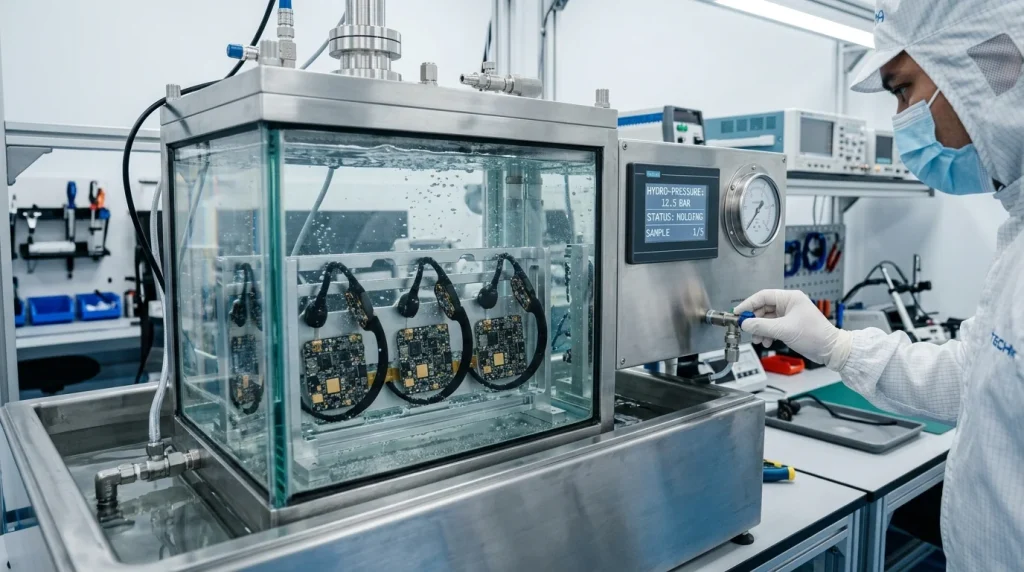
Every batch of ipx8 bone conduction headphones undergoes multi-stage submersion testing within pressurized air and water chambers. Verifying air-tightness before final battery integration prevents internal short circuits and ensures long-term underwater performance for commercial distributors.
AQL Level II Inspection and Automated Aging Protocols
Defect rate control in high-volume production requires continuous stress testing. Our facility subjects fully assembled units to 8-hour continuous battery burn-in cycles, thermal shock exposure, and mechanical drop tests to verify structural and electronic stability prior to packaging.
Adhering to strict quality control procedures under AQL Level II standards ensures that final export shipments maintain defect rates below 0.3%. Factory inspectors conduct frequency response analysis on every batch to verify microphone clarity and Bluetooth connection consistency.
Custom Tooling and Private Label ODM Production
Building a proprietary open-ear brand requires flexible OEM and ODM manufacturing support. Our engineering department provides turnkey tooling development, custom casing colors, tailored laser etching, and customized Bluetooth pairing names tailored to specific regional markets.
Protecting client IP is central to our manufacturing partnerships. We execute formal non-disclosure agreements and offer exclusive mold ownership options, allowing brand owners to launch unique open-ear audio products without risk of market duplication.
Cross-Border Logistics and Amazon FBA Compliance
Meeting European and North American retail standards requires complete regulatory compliance. Our open-ear devices maintain CE, FCC, and RoHS certifications, ensuring seamless customs clearance and hassle-free retail distribution across online and offline channels.
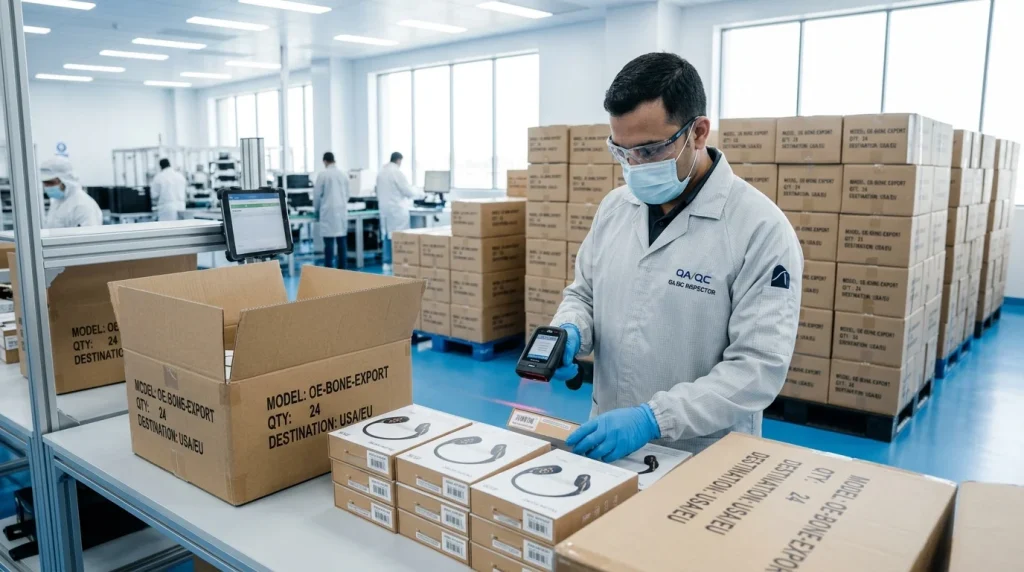
To support e-commerce sellers and Amazon FBA operations, we provide custom packaging prep, FNSKU barcode application, and direct fulfillment options. Streamlined dropshipping workflows allow global distributors to scale sales velocity without holding excess local inventory.
Frequently Asked Questions (FAQ)
What should I look for when choosing a bone conduction headphones factory?
A reliable factory should demonstrate cleanroom assembly capabilities, dedicated transducer calibration equipment, and documented waterproofing pressure test setups. B2B buyers must review factory ISO certifications, AQL sampling standards, and historical defect rates across high-volume production runs.
In the industry, evaluating manufacturing transparency prevents unexpected field failures; YAYAGG provides complete batch inspection reports, CE/FCC documentation, and low MOQ trial production to support global brand expansion.
How do manufacturers test waterproof headphones?
Factory testing involves both negative air pressure testing on empty enclosures and continuous hydro-pressure submersion on assembled units. Testing protocols evaluate seal integrity under simulated water depths exceeding 1.5 meters for extended timeframes.
Compared to standard factories that rely on passive water dipping, YAYAGG subjects 100% of swimming headphone enclosures to automated multi-bar pressure chambers before final battery installation.
What is the difference between OEM and ODM headphones?
OEM production applies custom logos, colors, and packaging to existing factory molds with rapid turnaround times. ODM production involves full engineering development, including customized acoustic cavity design, unique exterior tooling, and proprietary PCB circuit layouts.
YAYAGG works with brands that require both rapid white-label turnaround and complex ODM engineering, providing dedicated project management from initial 3D design to final mass production.
Which bone conduction headphone manufacturers work with Amazon sellers?
Suitable suppliers must understand Amazon FBA requirements, including drop-test compliant packaging, FNSKU labeling, outer carton compliance, and strict batch-to-batch quality stability to prevent listing suspensions.
For startups and Amazon sellers, YAYAGG supports compliant FBA prep services, flexible private label packaging, and dropshipping fulfillment designed to maintain account safety and low return rates.
Call to Action (CTA)
Scaling a successful audio brand requires a dependable supply chain partner focused on quality engineering and compliance. Whether you need custom OEM tooling, IPX8 waterproof swimming headsets, or white-label dropshipping, our team is equipped to support your growth. Contact our wholesale team to request technical datasheets or get a free quote today for your bulk order requirements.