
Overview
Understanding the manufacturing workflow of a bone conduction headphones production factory helps brands assess yield rates and structural reliability. From transducer acoustic calibration to IPX8 structural sealing, technical precision directly impacts product durability and market performance.
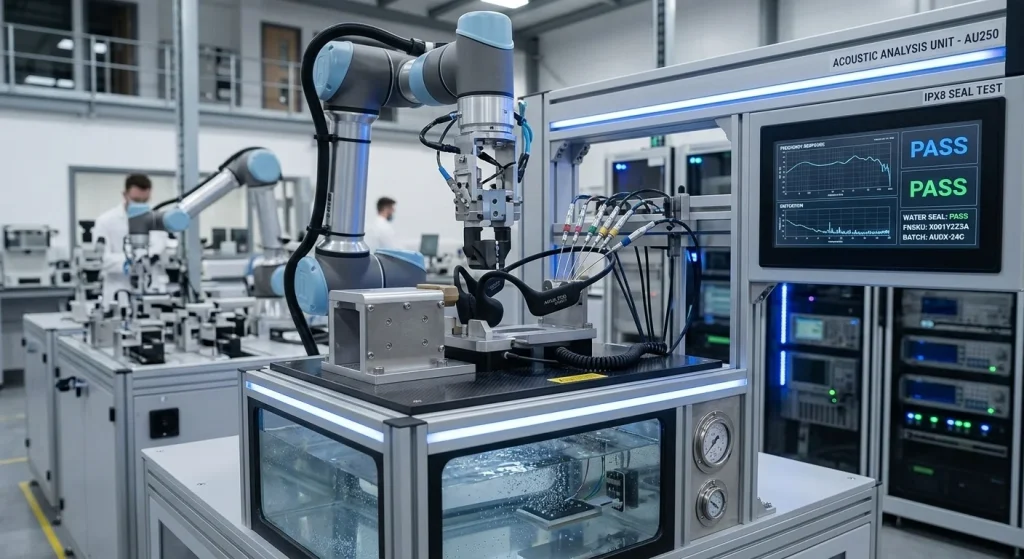
Precision Acoustic Engineering in Bone Conduction Manufacturing
Bone conduction technology bypasses the eardrum by transmitting sound vibrations directly through the temporal bone to the inner ear. Unlike traditional dynamic drivers, bone conduction transducers require precise mechanical alignment and rigid acoustic housing to minimize sound leakage while maximizing low-frequency performance.
In a commercial assembly line, automated acoustic testing rigs calibrate each transducer’s vibration response across targeted frequency spectrums. Modern manufacturing facilities integrate specialized damping materials and sealed enclosures, ensuring that bone conduction open ear headphones deliver crisp audio clarity without compromising structural integrity or user comfort during active wear.
       [ Piezoelectric / Magnetic Transducer ]
                          │
            (Structural Damping Layer)
                          │
   ┌──────────────────────┴──────────────────────┐
   ▼                                             ▼
[ Solid Acoustic Enclosure ]           [ Flexible Titanium Frame ]
   │                                             │
   └──────────────────────┬──────────────────────┘
                          ▼
            [ Vibration-Driven Bone Conduction ]
Structural Sealing and IPX8 Waterproofing Processes
Manufacturing reliable swimming headsets demands advanced sealing techniques that withstand prolonged liquid submersion. Standard liquid coatings are insufficient for true aquatic environments, requiring structural seals aligned with International Ingress Protection standards.
Factories utilize automated ultrasonic welding alongside precise silicone over-molding to eliminate micro-gaps around the chassis. Additionally, internal printed circuit boards (PCBs) receive hydrophobic nano-coatings, ensuring that IPX8 bone conduction headphones maintain full circuit stability even when subjected to static water pressures exceeding two meters depth.
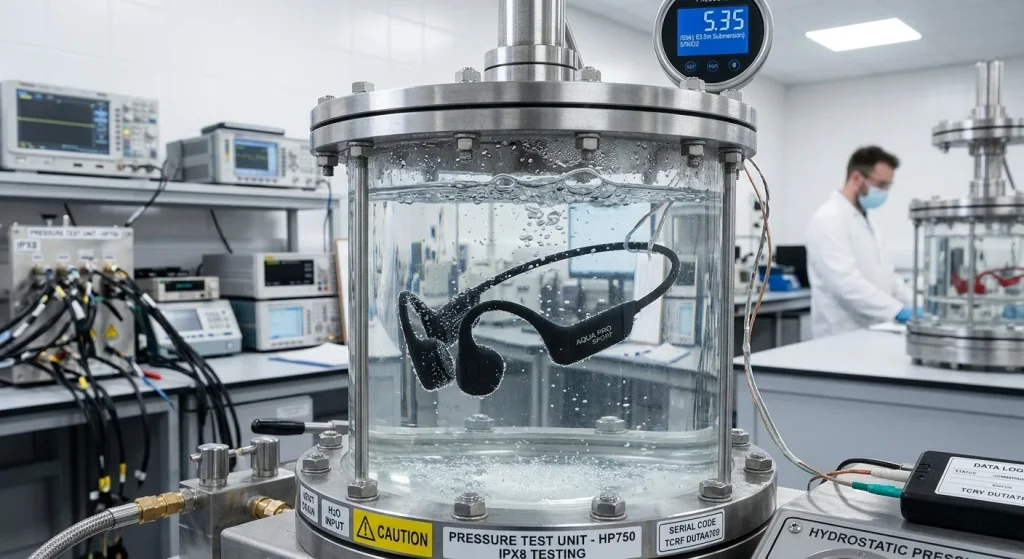
+-------------------------------------------------------------+
|               Multi-Layer IPX8 Water Protection             |
+-------------------------------------------------------------+
|  Level 1: Over-Molded Medical Silicone Enclosure            |
|  Level 2: Ultrasonic Cavity Welding & Gasket Seals          |
|  Level 3: Conformal PCB Nano-Coating (Internal Protection)  |
+-------------------------------------------------------------+
Factories utilize automated ultrasonic welding alongside precise silicone over-molding to eliminate micro-gaps around the chassis. Additionally, internal printed circuit boards (PCBs) receive hydrophobic nano-coatings, ensuring that IPX8 bone conduction headphones maintain full circuit stability even when subjected to static water pressures exceeding two meters depth.
Material Selection for Ergonomics and Durability
The structural frame of a premium sports headset must balance clamping force, flexibility, and fatigue resistance. Manufacturers standardly incorporate nickel-titanium (NiTi) shape-memory alloy wire wrapped in hypoallergenic silicone skins.
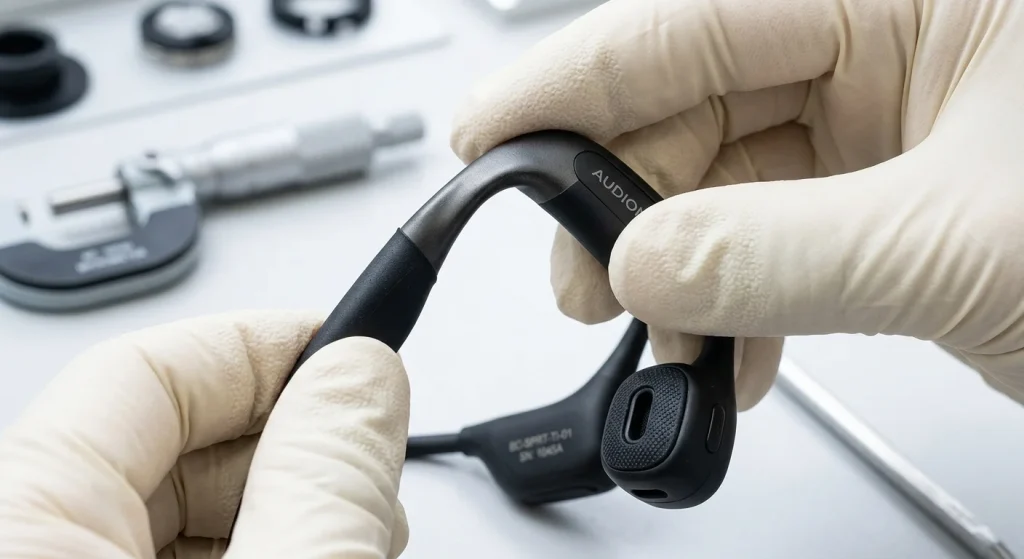
Automated bending machines shape the memory wire to ensure consistent pressure distribution across diverse head profiles. During raw material incoming quality control (IQC), raw silicone undergoes skin-sensitization testing, guaranteeing that finished units remain comfortable and sweat-resistant throughout intense athletic usage.
Signal Stability and Chipset Integration
Maintaining continuous Bluetooth connectivity presents unique technical hurdles, particularly when water attenuation affects high-frequency radio signals. Engineering teams must optimize antenna placement within compact, fully enclosed earphone cavities.
Modern assembly lines integrate Bluetooth 5.4 chipsets tuned alongside custom ceramic or LDS (Laser Direct Structuring) antennas. RF testing in anechoic chambers validates signal gain and power efficiency, ensuring stable wireless transmission across swimming, cycling, and running scenarios.
Stringent Quality Assurance and Environmental Aging Tests
B2B buyers evaluate factories based on rigorous quality management systems that prevent mass defect risks. Standardized testing protocols must simulate harsh operating environments before products leave the production floor.
Every batch undergoes automated air-pressure decay testing to verify watertight integrity prior to final packaging. Subsequently, finished units undergo multi-axis drop tests, sweat-corrosion chambers, and continuous 48-hour burn-in vibration tests to guarantee long-term field reliability. To review our complete ISO-compliant manufacturing standards and factory testing workflows, brands can examine our detailed production and quality assurance processes.
Streamlined OEM/ODM and Private Label Solutions
For international brand owners and Amazon sellers, turning a technical design into a scalable commercial product requires flexible production pipelines. Factories offer turnkey ODM engineering, from industrial mold tooling to custom firmware configuration.
Manufacturers streamline private label customization by offering high-precision laser marking for logos and tailored packaging solutions. Brands seeking to expand their athletic audio portfolio can work closely with engineering teams to adjust sound signatures, button mapping, and colorways with optimized lead times.
Frequently Asked Questions (FAQ)
What should I look for when choosing a bone conduction headphones factory?
Buyers should evaluate a factory’s acoustic calibration capability, waterproofing test standards, and IPX8 enclosure technology. Ensure the supplier operates cleanroom assembly areas, maintains automated air-leakage test rigs, and possesses international compliance certifications such as CE, FCC, and RoHS.
Compared to standard factories, YAYAGG focuses on specialized acoustic transducer tuning, low defect rates, and comprehensive supply chain support for global B2B clients.
What certifications should a headphone supplier have?
A reliable manufacturer must hold fundamental quality management credentials like ISO9001, alongside product-level compliance marks including CE, FCC, RoHS, and MSDS/UN38.3 for integrated lithium batteries.
For startups and Amazon sellers, YAYAGG supports full certification documentation packages to streamline customs clearance and platform compliance across European and North American markets.
What is the typical MOQ for custom bone conduction headphones?
Minimum Order Quantities (MOQs) vary depending on the depth of customization. Standard private label branding using existing tooling generally requires 500 to 1,000 units, whereas full ODM custom colorways or custom tooling may start at 2,000 units.
In the industry, YAYAGG provides flexible MOQ policies for small-batch market testing, allowing growing brands to scale inventory efficiently.
How do manufacturers test waterproof swimming headphones?
Factories utilize two primary testing phases: dry air-pressure decay testing to check cavity integrity, followed by actual water submersion pressure tanks that simulate depth exposure.
YAYAGG works with brands that require strict AQL quality standards, subjecting 100% of swimming units to positive air-pressure sealing tests prior to final assembly.
Call to Action (CTA)
Ready to launch or upgrade your open-ear sports audio lineup? Our engineering team provides end-to-end support from raw tooling to compliant global drop-shipping. To request product catalogs, review wholesale pricing, or discuss tailored OEM requirements, contact our wholesale team today and get your project moving forward.