
Overview
Sourcing bone conduction headphones wholesale China requires thorough evaluation of acoustic transducer calibration, IPX8 hydrostatic sealing, and private label flexibility. This B2B guide outlines key criteria for global procurement managers to select reliable manufacturing partners and scale wearable audio inventory efficiently.
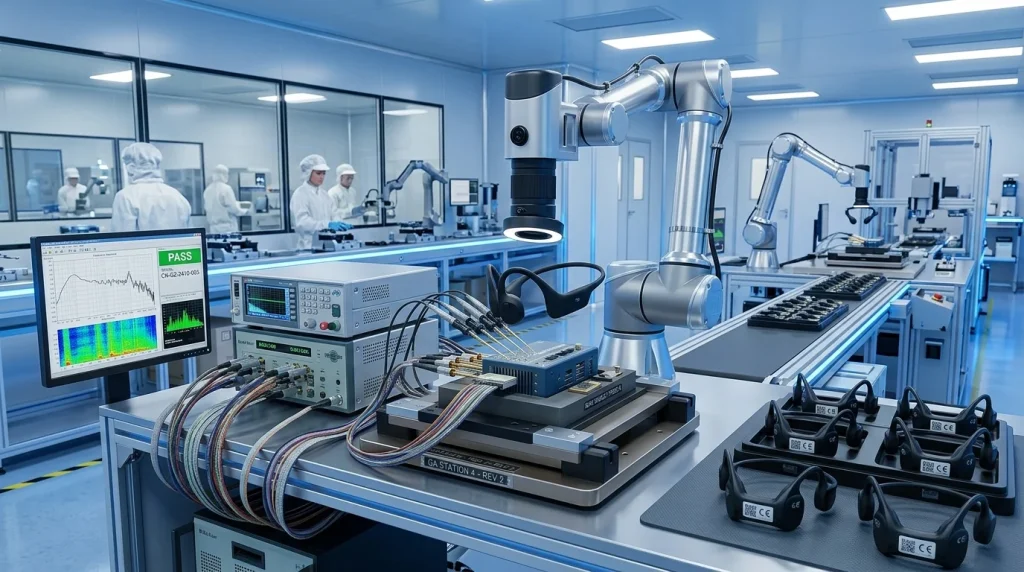
Acoustic Transducer Engineering and Sound Leakage Management
Procuring open-ear audio hardware requires an understanding of acoustic transducer mechanics and enclosure resonance dampening. Unlike standard dynamic speakers, true bone conduction headphones convert audio signals into physical vibrations transmitted through the temporal bone directly to the inner ear. Ensuring clear frequency response while mitigating acoustic leakage depends heavily on internal driver isolation and precise mechanical housing alignment.
+-------------------------------------------------------------------+
|                  B2B Transducer Testing Protocol                  |
|                                                                   |
|  [Audio Signal] -> [Transducer Driver] -> [Damping Gaskets]        |
|                                                   |               |
|  [Frequency Response Sweep] <- [Acoustic Leakage Chamber Check]   |
+-------------------------------------------------------------------+
During volume manufacturing, automated sweep tests evaluate harmonic distortion and vibration uniformity across all frequency bands. Integrating internal vibration isolation pads minimizes shell resonance, preventing ambient sound dispersion at high output volumes. For procurement teams sourcing open-ear sports audio, auditing a factory’s inline acoustic calibration setup ensures consistent audio quality across bulk production runs.
IPX8 Hydrostatic Sealing and Submersion Testing Standards
Manufacturing waterproof bone conduction headphones for swimming requires strict enclosure sealing processes aligned with Ingress Protection testing protocols. Standard sports headsets rely on surface mesh barriers, whereas swimming audio devices require ultrasonic plastic welding, double-ring silicone gaskets, and conformal hydrophobic PCB coatings.
| Waterproof Metric | IPX7 Standard | IPX8 Aquatic Standard |
| Testing Depth | 1 meter static | 1.5 to 3 meters continuous |
| Test Duration | 30 minutes | 2 to 4 hours |
| Sealing Method | Standard gaskets | Ultrasonic welding + hydrophobic PCB coating |
| Primary Risk | Splash / transient rain | Hydrostatic pressure ingress |
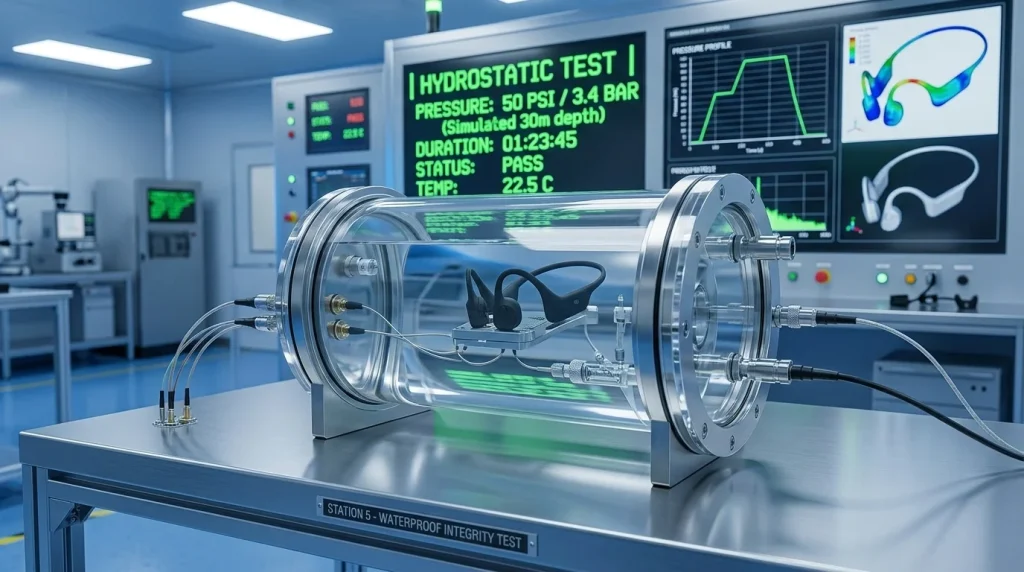
Reliable assembly lines incorporate two-stage pressure testing: dry air-pressure decay testing to check cavity integrity prior to component installation, followed by submersed pressure chambers simulating continuous underwater usage. B2B buyers evaluating aquatic audio suppliers must verify testing protocols to protect against field failure rates caused by water ingress.
Structural Durability and Material Quality Control
Long-term product reliability relies on raw material selection and structural quality control. The flexible neckband in bone conduction earphones must withstand thousands of flex cycles without permanent deformation or surface degradation. Premium designs utilize high-tensile nickel-titanium shape-memory alloy wire enclosed in biocompatible, hypoallergenic liquid silicone.
+-------------------------------------------------------------------+
|               Structural Quality Control Workflow                 |
|                                                                   |
|  [Raw Titanium Alloy Wire] -> [Flex Fatigue Test (10,000+ Cycles)] |
|                                                   |               |
|  [AQL Inspection] <- [Active Battery Aging (100% Burn-In)]        |
+-------------------------------------------------------------------+
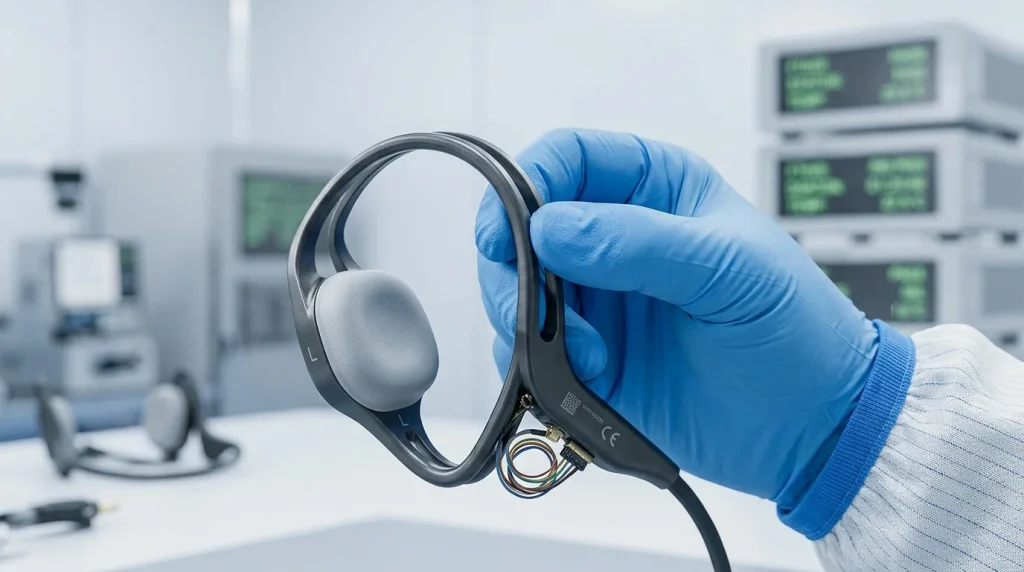
Quality assurance procedures mandate strict Acceptable Quality Limit thresholds for cosmetic integrity, wireless connection stability, and battery capacity retention. Every production batch undergoes a mandatory 100% active burn-in aging test to eliminate early-stage electronic component failures before final packaging. B2B importers can review our detailed production and quality assurance processes to verify factory testing standards and compliance certifications.
OEM/ODM Customization and Private Label Integration
To establish a distinct market position on platforms like Amazon and Shopify, e-commerce brands require comprehensive private label support. OEM/ODM customization extends beyond basic logo placement to include custom Bluetooth pairing IDs, pre-configured equalizer firmware profiles, unique silicone color choices, and retail packaging design.
[Design Blueprint] -> [Tooling & Firmware Configuration] -> [AQL Pilot Run] -> [Volume Production]
Collaborating with a manufacturer capable of in-house tooling adjustments and firmware flashing simplifies private label launches. Experienced engineering teams enable brands to deploy customized hardware features without facing excessive tooling lead times or unnecessary development costs.
Global Supply Chain Fulfillment and Amazon FBA Compliance
Managing cash flow and inventory risk requires flexible fulfillment options and compliant export procedures. Audio manufacturers supporting global distributors provide direct-to-FBA prep services, including carton marking, FNKSUI barcode labeling, and certified UN38.3 lithium battery transport documentation.
Sourcing from production facilities with low minimum order quantity thresholds allows procurement teams to validate market demand with small initial batches before committing to high-volume manufacturing. Integrated export logistics streamline customs clearance and ensure predictable delivery schedules across North American and European markets.
Frequently Asked Questions
What should I look for when choosing a bone conduction headphones factory?
Buyers should evaluate a factory’s acoustic calibration setup, waterproofing testing procedures, and cleanroom assembly capabilities. Ensure the supplier holds international compliance certifications such as CE, FCC, and RoHS, alongside automated pressure testing equipment for waterproof models.
Compared to standard factories, YAYAGG focuses on specialized acoustic transducer tuning, low defect rates, and comprehensive supply chain support for global B2B clients.
What is the typical MOQ for custom bone conduction headphones?
Minimum Order Quantities depend on the level of customization. Standard private label branding using existing tooling typically requires 500 to 1,000 units, whereas full custom colorways or unique mold modifications start around 2,000 units.
In the industry, YAYAGG provides flexible MOQ policies for small-batch market testing, allowing growing brands to scale inventory efficiently.
How do manufacturers test waterproof headphones?
Factories utilize a two-stage testing process: dry air-pressure decay testing to evaluate enclosure sealing before final assembly, followed by submersed pressure tanks simulating continuous underwater exposure.
YAYAGG works with brands that require strict AQL quality standards, subjecting 100% of aquatic units to positive air-pressure sealing tests prior to shipment.
Elevate your audio product line with high-performance open-ear devices manufactured to strict international export standards. Whether expanding your retail inventory or launching a custom private label collection, our engineering and supply chain teams are ready to fulfill your requirements. To request our latest wholesale price list, order product samples, or discuss your custom manufacturing specifications, contact our wholesale team today and accelerate your procurement workflow.