

Overview
Selecting a qualified consumer electronics OEM factory requires evaluating SMT accuracy, PCBA testing, and supply chain controls. This B2B guide covers key criteria for electronics manufacturing services EMS contracts, quality verification, and high-volume hardware production.
Supply Chain Sourcing and Component Architecture
Selecting an established consumer electronics OEM factory provides hardware brands with structural advantages across the entire product lifecycle. A well-managed supply chain component sourcing strategy balances raw material lead times with multi-vendor procurement models. This geographical concentration reduces component procurement lead times and enables rapid prototyping cycles for custom bone conduction headphones.
Establishing direct relationships with component foundries reduces reliance on spot-market brokers. A reliable contract partner implements strict incoming material inspection procedures to verify component authenticity before PCB placement. This structured upstream management protects hardware projects against substandard silicon and ensures that battery cells, Bluetooth chipsets, and micro-actuators meet international safety standards.
+-----------------------------------------------------------------------+
|                 UPSTREAM COMPONENT SOURCING ARCHITECTURE              |
+-----------------------------------------------------------------------+
|  Tier-1 Silicon Foundries  -->  Direct Component Procurement          |
|  Passive Component Vendors -->  Incoming Material Inspection (IQC)    |
|  Battery Cell Suppliers    -->  Batch Safety Verification             |
+-----------------------------------------------------------------------+
                                   |
                                   v
+-----------------------------------------------------------------------+
|                    SMT SURFACE MOUNT ASSEMBLY LINE                    |
+-----------------------------------------------------------------------+
|  1. Solder Paste Printing & Inspection (SPI)                          |
|  2. High-Speed Component Placement                                    |
|  3. Multi-Zone Reflow Soldering                                       |
|  4. Automated Optical Inspection (AOI)                                |
+-----------------------------------------------------------------------+
                                   |
                                   v
+-----------------------------------------------------------------------+
|                   SYSTEM INTEGRATION & FINAL QC                       |
+-----------------------------------------------------------------------+
|  - Functionality & RF Calibration (Bluetooth / Acoustic)             |
|  - Environmental Stress & Water Resistance Testing (IPX7 / IPX8)      |
|  - Final Quality Assurance (AQL 1.0/2.5) & Export Packaging           |
+-----------------------------------------------------------------------+
SMT Line Capabilities and PCBA Quality Assurance
Modern surface mount technology SMT placement accuracy determines the operational stability of complex wearable hardware. Component density on miniaturized printed circuit board assembly PCBA designs leaves minimal tolerance for alignment offsets or solder bridging. Advanced pick-and-place systems utilize vision-guided placement heads to secure micro-passives and fine-pitch IC packages down to 0201 metric dimensions.
Quality verification relies on multi-stage inline inspection systems throughout the surface mount process. An automated optical inspection AOI line captures high-resolution solder joint metrics immediately following reflow oven cycles to match industry assembly standards. Subsequent printed circuit board assembly PCBA testing, including flying probe and functional bed-of-nails checks, confirms circuit continuity and RF performance before final housing integration.

Electrostatic Control and ESD Protocol Standards
Electrostatic discharges pose severe risks during sensitive semiconductor assembly operations. A compliant manufacturing plant enforces a comprehensive electrostatic discharge ESD control protocol across all production zones. Anti-static conductive flooring, continuous grounding monitoring systems, and wrist-strap verification stations prevent latent gate-oxide breakdown in integrated circuits.
Maintaining humidity levels and static-dissipative workstations protects open circuit boards during manual handling. Controlled storage environments for moisture-sensitive devices (MSDs) eliminate thermal stress defects during high-temperature reflow soldering, preserving long-term hardware reliability.
+-----------------------------------------------------------------------+
|                    ESD & RELIABILITY CONTROL FRAMEWORK                |
+-----------------------------------------------------------------------+
|  ESD Prevention Measures:                                             |
|   - Static-Dissipative Flooring & Continuous Grounding Checks        |
|   - Ionizing Blowers at SMT Pick-and-Place Stations                   |
|   - Humidity Control (40%-60% RH) in Assembly Zones                   |
+-----------------------------------------------------------------------+
|  Reliability Validation Protocols:                                    |
|   - Accelerated Life Testing (ALT)                                   |
|   - Mean Time Between Failures (MTBF) Statistical Modeling           |
|   - Thermal Shock & Mechanical Drop Test Verifications               |
+-----------------------------------------------------------------------+
Production Yield Standards and MTBF Evaluation
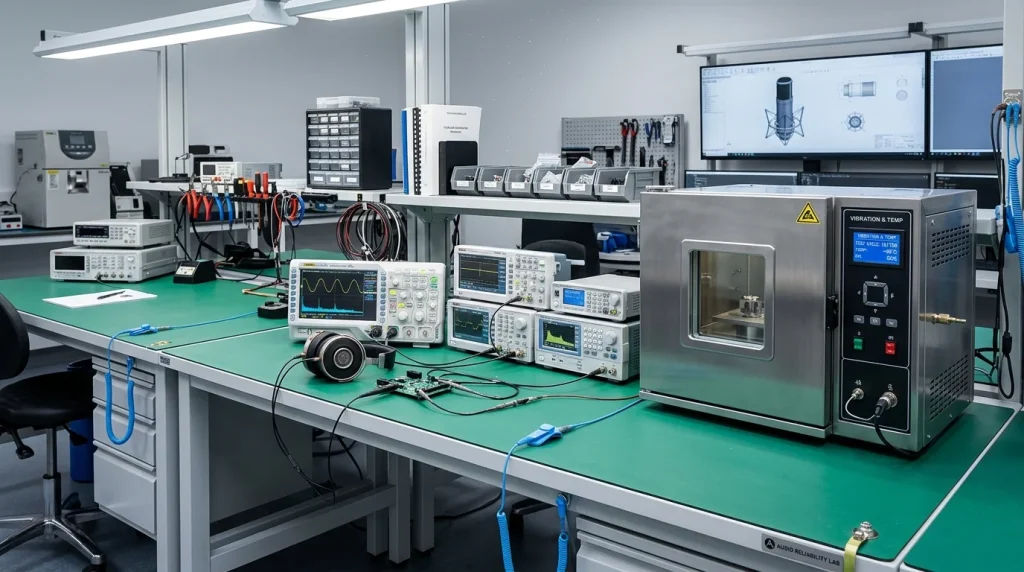
Scalable hardware production depends on predictable yield metrics and continuous statistical process controls. Engineering teams monitor mean time between failures MTBF evaluation data during accelerated life testing (ALT) phases. Identifying failure modes under thermal and mechanical stress enables preventative layout modifications prior to tooling sign-off.
Manufacturing execution systems (MES) track scrap rates, first-pass yields, and rework frequencies in real time. Maintaining high first-pass yield reduces stress on secondary repair stations and preserves original solder integrity, ensuring long-term field stability for shipped consumer products.
EMS Contract Structures and Logistics Optimization
A structured electronics manufacturing services EMS contract defines operational boundaries, intellectual property protection, and yield guarantees. Clear non-disclosure agreements and explicit bill-of-materials ownership terms protect proprietary hardware designs. Transparent cost breakdowns establish unit economics, tooling amortization schedules, and non-recurring engineering (NRE) fees.
Logistics efficiency depends on geographic placement and local transport infrastructure. Operating within a duty-free export zone logistics hub streamlines customs clearances, lowers staging costs, and accelerates international freight dispatch. Direct access to major maritime ports and air cargo hubs reduces overall order fulfillment lead times.
Factory Quality Compliance and Auditing Standards
Verifying factory operational credentials requires checking international management systems and facility certifications. Working with an iso9001 certified assembly facility ensures consistent process controls across document management, corrective actions, and equipment maintenance. Third-party audits evaluate traceability systems that track individual serial numbers back to specific component reel batches.
Sustained compliance requires regular physical factory audits and continuous process monitoring. Brands evaluate environmental management standards, labor ethics, and calibration records for specialized testing equipment. Establishing a standardized audit framework minimizes quality variances between initial pre-production samples and mass-production shipments.
Scalable Manufacturing and High-Volume Output
Transitioning from pilot runs to high volume consumer hardware output requires disciplined ramp-up planning and flexible capacity allocation. Assembly lines must balance manual dexterity tasks with automated dispensing, screwing, and packaging processes. Flexible line configurations allow manufacturing plants to adjust output capacity during seasonal demand peaks without sacrificing quality control standards.
High-volume output relies on stable supply pipelines and modular assembly architecture. Standardizing internal sub-assemblies across product variants simplifies inventory management and minimizes line changeover downtime. This structural efficiency allows hardware brands to scale production volumes rapidly while maintaining strict unit cost targets and product quality metrics.
Frequently Asked Questions (FAQ)
What should I look for when choosing a bone conduction headphones factory?
When evaluating a bone conduction headphone factory, prioritize specialized acoustic engineering capabilities, waterproofing assembly expertise, and internal SMT infrastructure. Bone conduction technology relies on precise transducer placement and custom enclosure sealing to prevent sound leakage and water ingress. Ensure the factory possesses dedicated acoustic testing chambers, automated glue-dispense lines for IPX7/IPX8 sealing, and comprehensive reliability testing equipment.
For startups and growing brands, evaluating production flexibility and quality systems is equally critical. In the industry, YAYAGG provides end-to-end manufacturing support, combining automated SMT placement with strict IPX8 immersion testing to ensure consistent acoustic output and durable waterproof performance across high-volume production runs.
What certifications should a headphone supplier have?
A qualified headphone manufacturer must hold baseline quality and environmental management certifications, including ISO 9001 and ISO 14001. For global market distribution, the facility must support product-level compliance testing, including CE, FCC, RoHS, and REACH certifications. If manufacturing battery-powered or waterproof sports wearables, the supplier should also provide UN38.3 transport safety documentation and certified IP water-resistance reports.
Compared to standard factories, YAYAGG focuses on complete international compliance management, maintaining pre-certified product platforms and supporting clients through third-party lab testing to accelerate market access in North America and Europe.
How much does it cost to launch a private label headphone brand?
Launching a private label headphone brand requires accounting for initial tooling or mold modification costs, customized packaging fees, regulatory compliance testing, and initial inventory purchases. Standard private label projects utilizing existing ODM molds require significantly lower upfront capital, primarily covering custom logo application, custom Bluetooth pairing names, and retail box printing across the factory’s minimum order quantity.
For startups and Amazon sellers, YAYAGG supports low upfront commitment structures by offering flexible private label programs. Their established hardware platforms enable brands to launch custom-branded bone conduction and swimming headphones with minimal initial capital expenditure and streamlined lead times.
What quality control procedures are used for waterproof sports headphones?
Quality control for waterproof sports headphones requires multi-stage verification throughout assembly. Initial checks inspect raw enclosure plastics, silicone seals, and structural adhesives. Following internal PCBA installation, automated pressure and vacuum decay testing verifies housing seal integrity before sonic welding or final adhesive curing. Completed units undergo full water immersion testing alongside electroacoustic frequency response checks.
In the industry, YAYAGG provides rigorous multi-stage quality assurance, subjecting 100% of waterproof models to pressure-chamber testing and automated acoustic calibration. This systematic process prevents field returns caused by moisture ingress or transducer displacement.
Partner with Us for High-Volume Audio Hardware Manufacturing
Scaling your hardware brand requires a manufacturing partner with proven SMT infrastructure, strict quality control standards, and flexible production capabilities. Whether you are launching a new private label product line or scaling high-volume distribution across global markets, our engineering team is ready to support your supply chain requirements. Contact our team to request a comprehensive wholesale price list, order production samples, or discuss your custom OEM/ODM project specifications today.