
This comprehensive analysis explores the science behind IPX8 waterproof ratings and examines how triple-seal technology—combining nano-coating, adhesive dispensing, and ultrasonic welding—has revolutionized the design and performance of swimming headphones. The article provides detailed technical insights into water resistance mechanisms, manufacturing processes, and industry applications.
The evolution of personal audio devices has consistently pushed technological boundaries, with waterproof capability emerging as a critical differentiator in the market. Swimming headphones represent a specialized segment where advanced sealing technologies enable audio experiences in aquatic environments. Understanding the science behind IPX8 ratings and triple-seal technology provides essential insights for industry professionals and consumers seeking reliable water-resistant audio solutions.
Definition
What is IPX8? IPX8 represents the highest level of liquid ingress protection as defined by the IEC 60529 international standard, indicating that a device can withstand continuous submersion in water beyond one meter depth for specified durations, typically 30 minutes or longer under manufacturer-defined conditions.
Understanding IPX8 Waterproof Ratings
The Ingress Protection (IP) rating system provides standardized measurements for electronic device protection against solid objects and liquids. The IPX8 classification specifically addresses water resistance under immersion conditions, going beyond lower ratings such as IPX7 (temporary submersion) and IPX5-IPX6 (water jet resistance). For swimming headphones, achieving true IPX8 certification requires comprehensive engineering solutions that address multiple potential failure points including speaker membranes, battery compartments, button interfaces, and charging ports. The rating indicates that under controlled laboratory conditions, the device has demonstrated functionality after submersion at depths specified by the manufacturer, though actual performance may vary based on environmental factors including water temperature, pressure duration, and chemical composition.
Key Points
- IPX8 rating indicates protection against continuous submersion beyond 1 meter depth for specified durations
- Triple-seal technology combines multiple protection layers for comprehensive water resistance
- Nano-coating application provides molecular-level protection on internal and external surfaces
- Adhesive dispensing seals complex geometries and microscopic gaps in electronic assemblies
- Ultrasonic welding creates permanent, hermetic bonds between dissimilar materials
- Integration of these technologies enables reliable swimming headphone performance
- Understanding IPX8 specifications helps consumers make informed purchasing decisions
The Triple-Seal Technology Explained
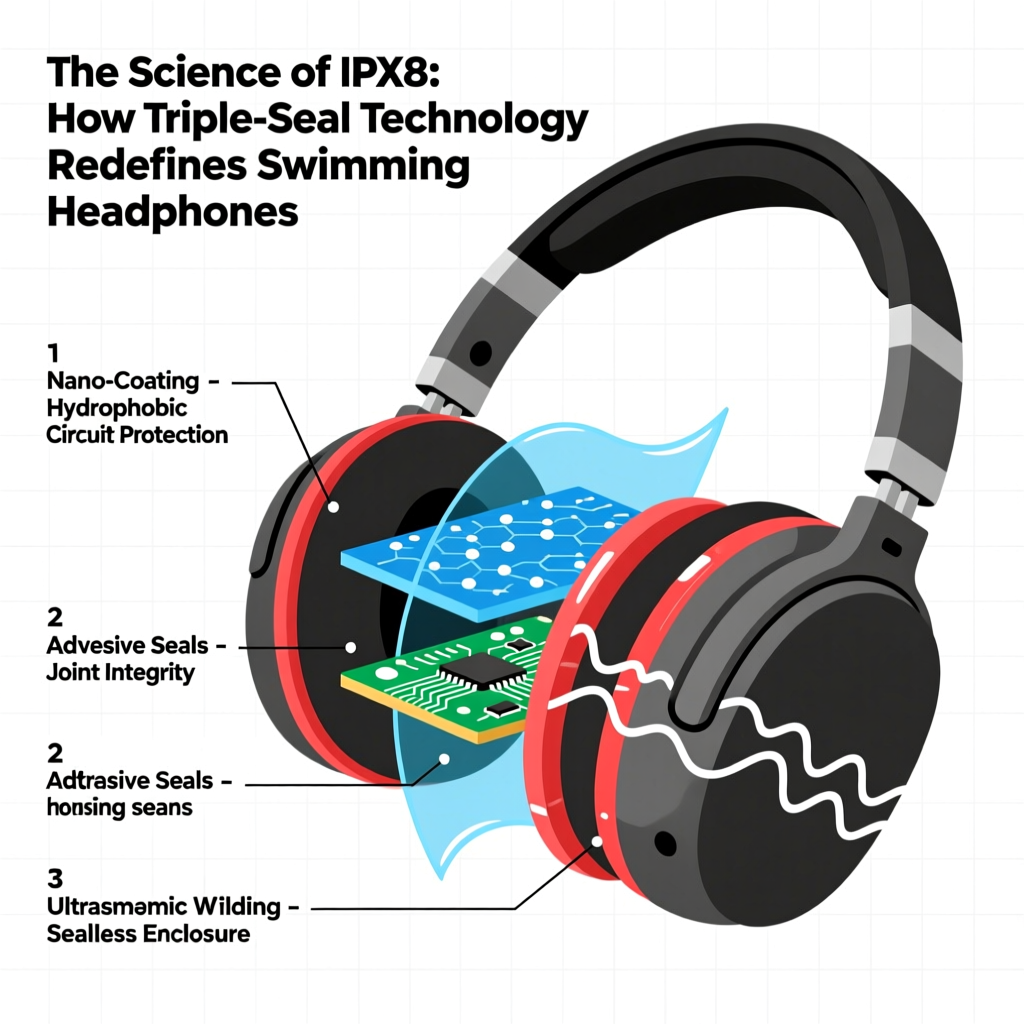
Triple-seal technology represents an advanced manufacturing approach that integrates three distinct protection mechanisms: nano-coating, adhesive dispensing, and ultrasonic welding. This multi-layered strategy addresses different aspects of water ingress prevention, creating a comprehensive barrier system that exceeds the capabilities of traditional single-method sealing techniques. The synergy between these technologies enables swimming headphones to achieve and maintain IPX8 certification throughout extended product lifecycles.
Manufacturing Process: Three-Layer Protection System
The manufacturing process for IPX8-certified swimming headphones employs a sophisticated three-layer protection system developed through extensive research and testing at specialized facilities. Each layer serves a specific function and contributes to overall water resistance performance.
- Step 1: Nano-Coating Application The first protection layer involves applying hydrophobic nano-coatings to all electronic components and circuit boards. This process utilizes advanced materials science where nanoscale particles create an invisible barrier that repels water molecules at the molecular level. The nano-coating fills microscopic surface irregularities and creates a uniform hydrophobic layer that prevents water from establishing contact with conductive elements. Application typically occurs in controlled clean-room environments to ensure complete and even coverage.
- Step 2: Adhesive Dispensing The second layer employs precision adhesive dispensing technology to seal joints, seams, and component interfaces. Automated dispensing systems apply measured quantities of waterproof adhesives in precise patterns, filling gaps between housing components and creating flexible yet durable seals. This process addresses the complex geometries inherent in headphone designs where multiple parts must be joined while maintaining electrical functionality for buttons, drivers, and charging contacts. Adhesive selection considers factors including flexibility after curing, temperature resistance, and long-term stability.
- Step 3: Ultrasonic Welding The third and final protection layer utilizes ultrasonic welding to create permanent hermetic seals between plastic housing components. High-frequency ultrasonic vibrations generate localized heat that fuses thermoplastic materials at the molecular level, producing weld strengths approaching or exceeding the base material. This process eliminates the need for mechanical fasteners or adhesive joints in critical areas, providing bubble-tight seals that maintain integrity under pressure changes encountered during aquatic activities.
Comparison Analysis
| Feature | Traditional Waterproofing | Triple-Seal Technology |
|---|---|---|
| Protection Mechanism | Single-layer silicone gaskets | Multi-layer integrated system |
| Seal Durability | Dependent on gasket compression and degradation | Permanent bonds with consistent performance |
| Manufacturing Consistency | Variable based on gasket fitting tolerance | Automated precision with reduced human error |
| Maintenance Requirements | Periodic gasket inspection and replacement | No scheduled maintenance for seal integrity |
| Pressure Resistance | Limited to specific depth ratings | Enhanced performance under variable pressures |
| Component Integration | Gaskets may interfere with button operation | Seamless integration preserves functionality |
| Production Cost | Lower initial cost, higher long-term expense | Higher initial investment, lower lifecycle cost |
Practical Applications and Usage Guidelines
Understanding the capabilities and limitations of IPX8-rated swimming headphones enables users to maximize device performance while ensuring longevity. Swimming headphones incorporating triple-seal technology provide reliable audio playback during various water-based activities including lap swimming, water aerobics, and recreational water sports. The technology has enabled audio manufacturers to expand product applications beyond traditional terrestrial use, creating new market opportunities and enhancing user experiences for fitness enthusiasts who incorporate aquatic exercise into their routines. Users should note that while IPX8 certification indicates water resistance during submersion, performance may be affected by factors including extended exposure duration, water temperature extremes, and exposure to chemicals found in chlorinated pools or saltwater environments.
Industry Implications and Future Developments
The advancement of triple-seal technology has significant implications for the consumer electronics industry, particularly in the sports audio segment. As manufacturers continue to refine these manufacturing processes, consumers can expect improved reliability, extended product lifespans, and broader applications for water-resistant audio devices. Research and development efforts continue to explore new materials and processes that could further enhance water resistance capabilities while reducing manufacturing complexity and cost. The convergence of improved sealing technology with advances in battery technology, audio quality, and wireless connectivity positions water-resistant headphones as a permanent and expanding category within the personal audio market. Industry analysts observe that products demonstrating reliable waterproof performance increasingly influence consumer purchasing decisions, particularly among fitness-focused demographics who incorporate aquatic exercise into their wellness routines.
Frequently Asked Questions
In conclusion, the science of IPX8 ratings and triple-seal technology represents a significant advancement in the development of swimming headphones. The integration of nano-coating, adhesive dispensing, and ultrasonic welding creates a comprehensive protection system that enables reliable aquatic audio experiences. As technology continues to evolve, these innovations will shape the future of water-resistant personal audio devices, meeting the growing demand for durable, high-performance equipment in aquatic fitness and recreational applications. For more information about waterproof audio technology research and development, visit our R&D documentation or explore our complete range of waterproof audio solutions.