
Quality Audits for Bulk Bone Conduction Headphones
OVERVIEW
This technical guide analyzes the primary manufacturing defects in open-ear audio equipment, focusing on acoustic leakage, structural fatigue, and moisture ingress. It provides enterprise buyers with clear engineering benchmarks to evaluate supplier reliability.
Acoustic Leakage and Transducer Calibration
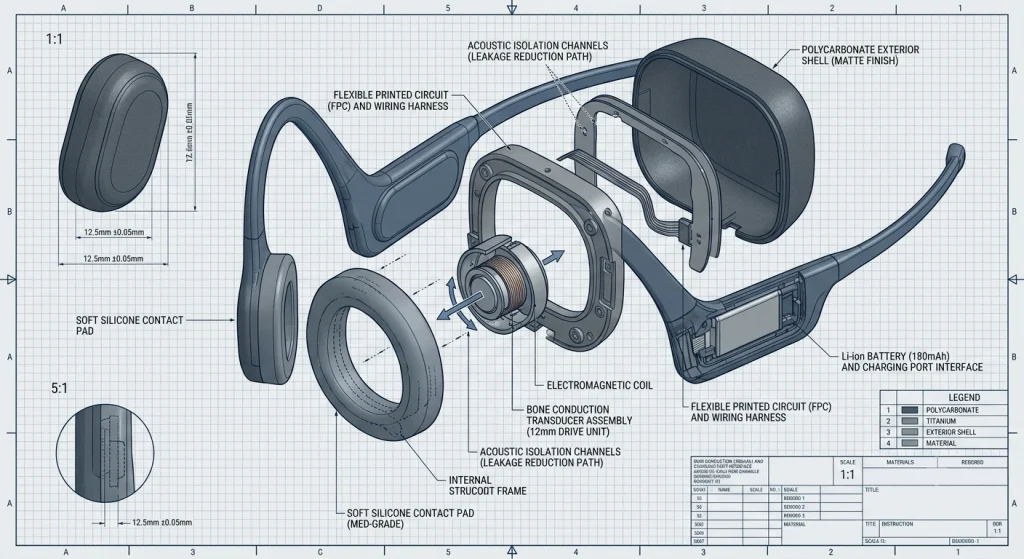
Acoustic leakage represents a primary hardware challenge in open-ear engineering. When sourcing bulk bone conduction headphones, improper housing tolerances or misaligned suspension components cause sound waves to escape into the air rather than transmitting through the temporal bone. This defect compromises user privacy and acoustic performance in professional commercial environments.
To mitigate this, manufacturers must implement structural isolation chambers around the mechanical transducers. Our engineering team utilizes high-precision silicone overmolding to isolate vibrations, ensuring that audio signals remain direct and contained. Enterprise buyers can examine these structural specifications within our About Us page to verify our advanced manufacturing capabilities.
Enclosure Sealing and IPX8 Moisture Ingress
For sports and aquatic audio, water entry causes immediate circuit shorting and corrosion. Many low-grade suppliers fail to maintain uniform adhesive dispensing along the split lines of the housing, resulting in microscopic gaps. Under pressure or heavy sweat, these gaps allow moisture to bypass the outer shell and destroy the internal PCBA.
Eliminating this vulnerability requires automated double-shot injection molding and dedicated vacuum pressure testing. Our production facility subjects every batch to rigorous underwater testing chambers to guarantee true legal compliance with IEC IP waterproof ratings. This specialized manufacturing focus ensures long-term operational durability for global distributors and importers.

Mechanical Fatigue of Titanium Memory Wires
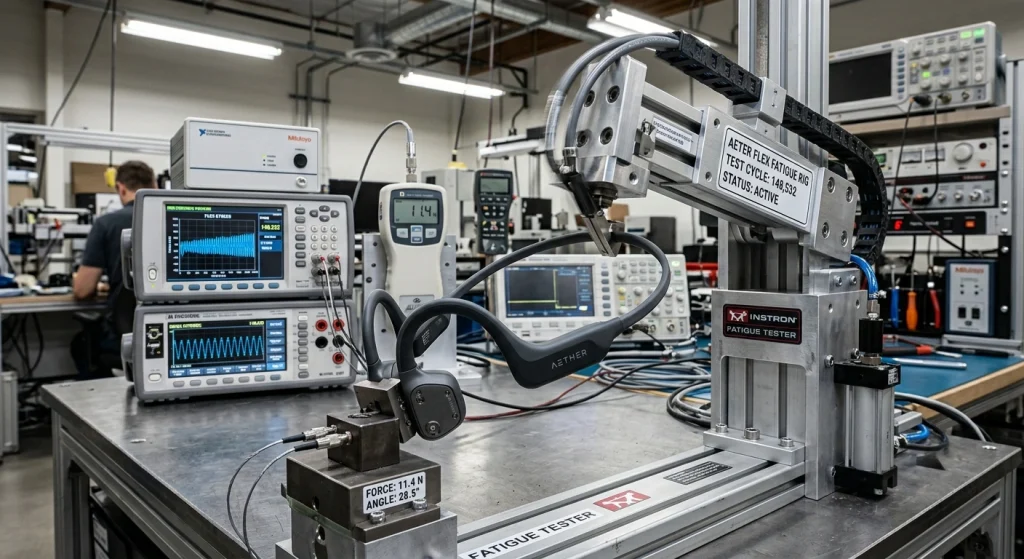
The rear neckband of open-ear hardware relies on a flexible titanium alloy core to maintain clamping force. Inferior suppliers often substitute premium medical-grade titanium with cheaper, brittle alloys that suffer from plastic deformation after repeated flexing. This causes the headset to lose its ergonomic shape, reducing transducer contact pressure against the wearer’s skin.
Professional QA protocols mandate automated flex-testing rigs that simulate thousands of expansion cycles. Maintaining structural elasticity is critical for running and swimming applications where secure fitting impacts audio delivery. Buyers can explore our specialized bone conduction headphones inventory to analyze our reinforced ergonomic blueprints.
Contact Corrosion in Charging Interfaces
Traditional exposed copper charging pins quickly corrode when exposed to human sweat or saline pool water. This electrochemical degradation blocks current flow, preventing the device from charging or interfacing with data cables. It stands as one of the highest-rated causes for post-sale consumer returns in the sports electronics sector.
The optimal solution involves moving away from standard exposed metal to gold-plated magnetic pogo pins or implementing specialized anti-corrosion coatings. Our factory utilizes a proprietary multi-layer plating process that resists sweat acidity and oxidation. This industrial-grade detailing protects your brand reputation across demanding retail networks.
Battery Management and Thermal Stability
Battery degradation in compact wireless audio often stems from inadequate Protection Circuit Modules (PCMs). Without precise overcharge and over-discharge safeguards, lithium-polymer cells swell, warping the plastic enclosure and creating severe safety hazards. This risk multiplies when devices are exposed to variable outdoor temperatures during athletic use.
Ensuring component safety requires rigorous supplier auditing and the deployment of Tier-1 battery cells. Independent brands must verify that their manufacturing partners execute 100% capacity grading and cycling inspections before final assembly. Implementing these stringent protocols prevents premature power failure and preserves long-term product lifecycles.
FAQ
How to check headphone factory quality before bulk order?
Corporate buyers should request a comprehensive factory audit covering ISO 9001 certifications, incoming material quality control (IQC) processes, and dedicated testing equipment availability. Evaluating existing pre-shipment inspection reports provides clear evidence of how technical tolerances and defect limitations are managed across large production volumes.
Requesting initial golden samples manufactured on actual production tooling allows engineers to evaluate real-world acoustic performance and build quality. Comparing this sample directly against subsequent mass-production outputs establishes a baseline for assessing ongoing mechanical consistency.
What is AQL inspection for headphone production?
AQL inspection is a mathematical approach that defines the maximum allowable defects in a random sample size pulled from a headphone batch. It uses standardized tables to establish specific thresholds for critical, major, and minor defects, giving buyers clear pass-or-fail metrics before dispatch.
We enforce a strict quality control framework matching AQL 1.5 for major functional variances and AQL 4.0 for minor cosmetic blemishes. This structured methodology ensures that global distributors receive uniform product shipments that fully comply with international retail standards.
What certifications do headphone factories need for EU US?
Exporting consumer electronics to Western markets requires compliance with foundational safety and environmental legal frameworks. For the European Union, factories must hold valid CE marking, RoHS directives for hazardous materials, and WEEE documentation for electronic waste disposal.
For the United States market, Federal Communications Commission (FCC) authorization is mandatory for all wireless Bluetooth components to verify radio frequency compliance. Additionally, specialized marine audio or swimming gear requires certified IPX8 ingress protection documentation to legally validate technical marketing claims.
CTA
As an established hardware supplier, we engineer our open-ear product lines to eliminate these common structural vulnerabilities before assembly. If you are ready to secure a reliable manufacturing partner for your distribution network, please contact our wholesale team to request technical spec sheets or discuss your bulk order requirements today.
How to check headphone factory quality before bulk order?
Corporate buyers should request a comprehensive factory audit covering ISO 9001 certifications, incoming material quality control (IQC) processes, and dedicated testing equipment availability. Evaluating existing pre-shipment inspection reports provides clear evidence of how technical tolerances and defect limitations are managed across large production volumes.
Requesting initial golden samples manufactured on actual production tooling allows engineers to evaluate real-world acoustic performance and build quality. Comparing this sample directly against subsequent mass-production outputs establishes a baseline for assessing ongoing mechanical consistency.
What is AQL inspection for headphone production?
AQL inspection is a mathematical approach that defines the maximum allowable defects in a random sample size pulled from a headphone batch. It uses standardized tables to establish specific thresholds for critical, major, and minor defects, giving buyers clear pass-or-fail metrics before dispatch.
We enforce a strict quality control framework matching AQL 1.5 for major functional variances and AQL 4.0 for minor cosmetic blemishes. This structured methodology ensures that global distributors receive uniform product shipments that fully comply with international retail standards.
What certifications do headphone factories need for EU US?
Exporting consumer electronics to Western markets requires compliance with foundational safety and environmental legal frameworks. For the European Union, factories must hold valid CE marking, RoHS directives for hazardous materials, and WEEE documentation for electronic waste disposal.
For the United States market, Federal Communications Commission (FCC) authorization is mandatory for all wireless Bluetooth components to verify radio frequency compliance. Additionally, specialized marine audio or swimming gear requires certified IPX8 ingress protection documentation to legally validate technical marketing claims.