
sports headphones manufacturer
Overview
This technical evaluation compares bone conduction technology with traditional earbuds for aquatic applications, focusing on acoustic efficiency, ear health, and mechanical sealing standards required by commercial distributors.
Acoustic Transmission Mechanisms in Submerged Environments
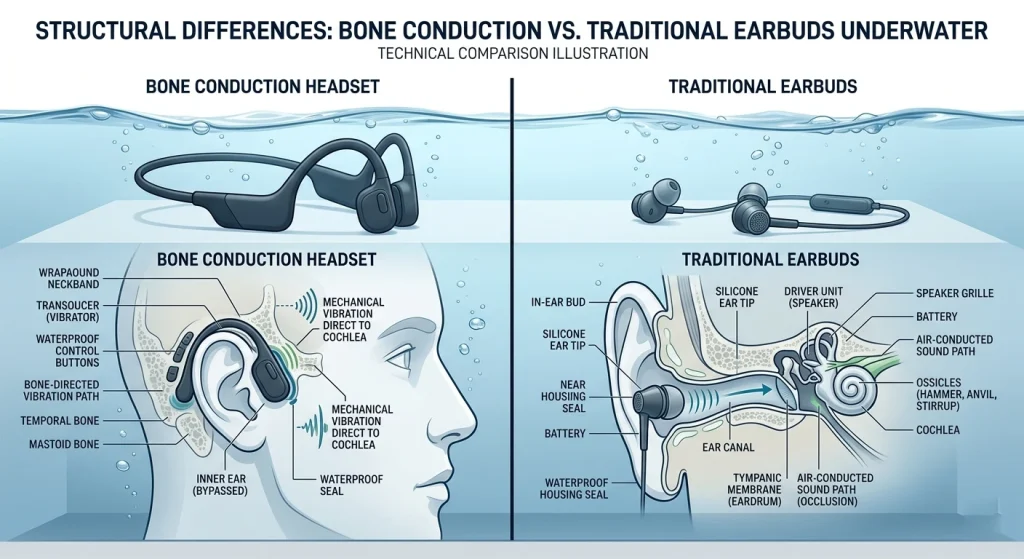
Traditional in-ear earbuds rely on air-conduction dynamics, moving a physical diaphragm to vibrate air molecules inside the ear canal. When a swimmer is submerged, any water ingress between the earbud tip and the tympanic membrane instantly dampens these sound waves, causing a severe volume drop and a muffled audio profile.
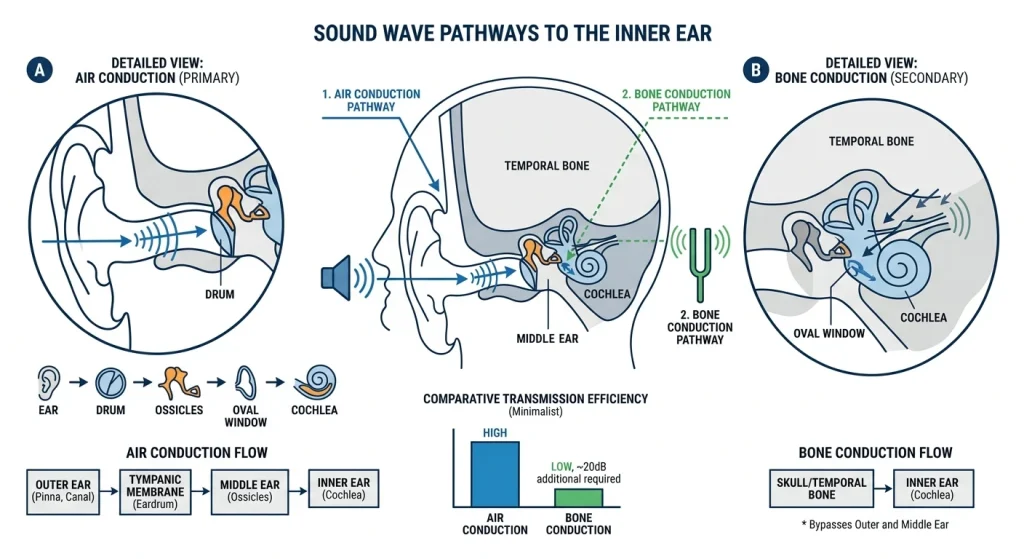
As an experienced sports headphones manufacturer, we bypass this physical limitation by engineering localized bone conduction transducers. These solid-state components eliminate the air medium entirely, transmitting mechanical vibrations directly through the temporal bone to the user’s inner ear, ensuring consistent audio fidelity underwater.
Ear Canal Hygiene and Health During Prolonged Submersion
Traditional earbuds require a tight physical seal within the ear canal to maintain acoustics and prevent water entry. However, this mechanical occlusion traps moisture and sweat inside the canal during intensive swimming sets, creating an optimal breeding ground for bacterial infections like otitis externa.
In contrast, open-ear bone conduction solutions leave the auditory canal fully unobstructed. This structural approach allows water to drain naturally from the ears during laps, drastically reducing post-swim medical risks for end-users and lowering warranty return rates for commercial distributors.
Hydrodynamic Stability and Retention Performance
The hydrodynamic forces exerted on a swimmer during flip turns or high-velocity strokes generate significant fluid drag. Traditional earbuds rely strictly on friction within the ear canal for retention, making them highly susceptible to shifting, loosening, or completely dislodging under water pressure.
Our structural engineering utilizes continuous titanium wire frames that wrap securely around the occipital bone. This tension-band design distributes clamping force evenly across stable cranial entry points, maintaining strict alignment and device retention regardless of water turbulence or physical acceleration.
Mechanical Sealing Realities and IPX8 Structural Reliability
Achieving a sustainable IPX8 rating for traditional earbuds is complex due to the acoustic venting required by moving speaker cones. Over extended submersion cycles, the flexible acoustic membranes inevitably suffer from micro-tears and material fatigue under localized hydrostatic pressure differentials.
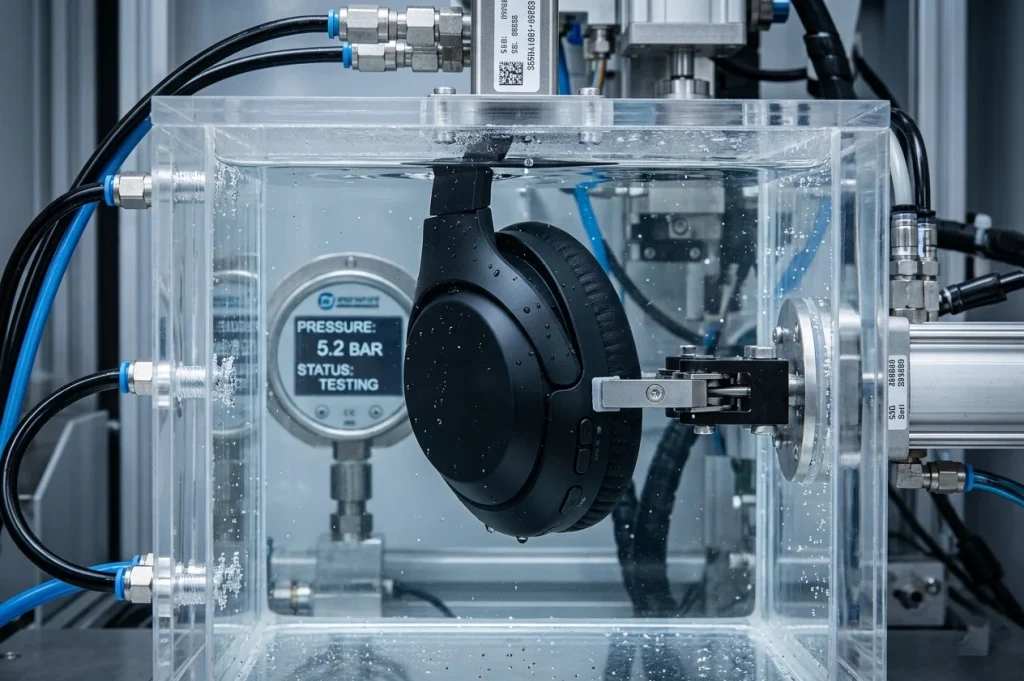
By eliminating moving diaphragms, bone conduction hardware allows for completely encapsulated enclosures. Our manufacturing workflow utilizes advanced overmolding and hermetic sealing processes, yielding a monolithic structural casing that withstands continuous underwater pressure without structural degradation.
FAQ
Can swimming headphones really work underwater?
Yes, dedicated aquatic audio hardware is engineered to maintain complete functionality during continuous submersion. Unlike standard consumer electronics, these specialized units rely on structural vibration or internal flash storage to deliver clear audio without relying on air-transmission paths.
Our production standards ensure that the mechanical architecture withstands hydrostatic pressure variations. This robust design guarantees consistent performance across prolonged commercial distribution lifecycles in both chlorinated and saline environments.
What waterproof rating is needed for sports headphones?
An IPX8 rating is mandatory for any audio hardware intended for swimming or active aquatic training. This classification certifies that the device housing prevents water ingress during continuous immersion under specific pressure thresholds.
Lower ratings like IPX7 are insufficient for the dynamic pressure changes encountered during active swimming strokes. Our hardware exceeds baseline IPX8 benchmarks to provide an engineered safety margin for international commercial distribution.
What is difference between open-ear and in-ear headphones?
In-ear headphones require physical insertion into the canal, blocking external ambient sounds and relying on air conduction. Open-ear headphones utilize structural transducers positioned outside the canal, leaving the ear completely open to the surrounding environment.
For commercial procurement, open-ear designs offer superior biological hygiene and situational safety. This distinct separation allows product distributors to clearly differentiate their inventory portfolios in competitive regional markets.
CTA
Navigating the technical nuances of aquatic audio hardware requires a reliable partner. We provide the manufacturing expertise and rigorous compliance necessary to secure your competitive edge in international markets. To obtain our comprehensive Wholesale Price List or to discuss your bulk order requirements, please contact our wholesale team today to review customized OEM specifications.